What Is Scrim And Sarking?
Sarking is rough-sawn timber, often rimu or kauri, nailed horizontally across the studs. Scrim is hessian tacked over those boards so wallpaper has something to hang on. It was the standard way to line a timber house in New Zealand before plasterboard took over.
It was built for wallpaper and nothing else. The paper bridges the gaps between boards, so it splits along the board lines as the house moves on its piles, billows when a door slams, and sags wherever the tacks have let go.
There is a safety side as well. Scrim is dry hessian against dry timber, and it burns fast. Some insurers ask whether a house still has scrim linings, so check your policy before you decide to keep it.
Can You Paint Or Plaster Straight Over Scrim?
No. Scrim has no rigid backing. Paint cracks at every board gap within a season, and stopping compound or a skim coat has nothing solid to grip. A painted finish needs a rigid sheet lining underneath, which in practice means plasterboard.
That leaves three honest options: line over the sarking, strip back to the studs, or keep the wall as a papered wall.
Lining Over The Sarking
The scrim and paper come off, loose boards are nailed back, and our GIB® fixing specialists screw new board through the sarking into the studs.
It is the faster and cleaner route. There is less demolition and less dust, the sarking keeps stiffening the wall, and you end up with solid timber behind the board almost anywhere you want to hang a shelf.
The catches are worth knowing before you choose it:
- The wall gets thicker. Skirtings, architraves and scotia were fitted to the old surface. Either they come off and go back on over the new board, or the sheets are butted up to them. Butting up is quicker, and it always looks like a shortcut, because the trim ends up almost flush with the wall and loses its shadow line.
- Sarking is not flat. Boards vary in thickness and cup with age. We pack the low spots and plane the high ones before any board goes on. Skip that step and the wave shows through the first coat of paint.
- Nothing inside the wall changes. No insulation goes in, and the old wiring stays where it is.
Stripping Back To The Studs
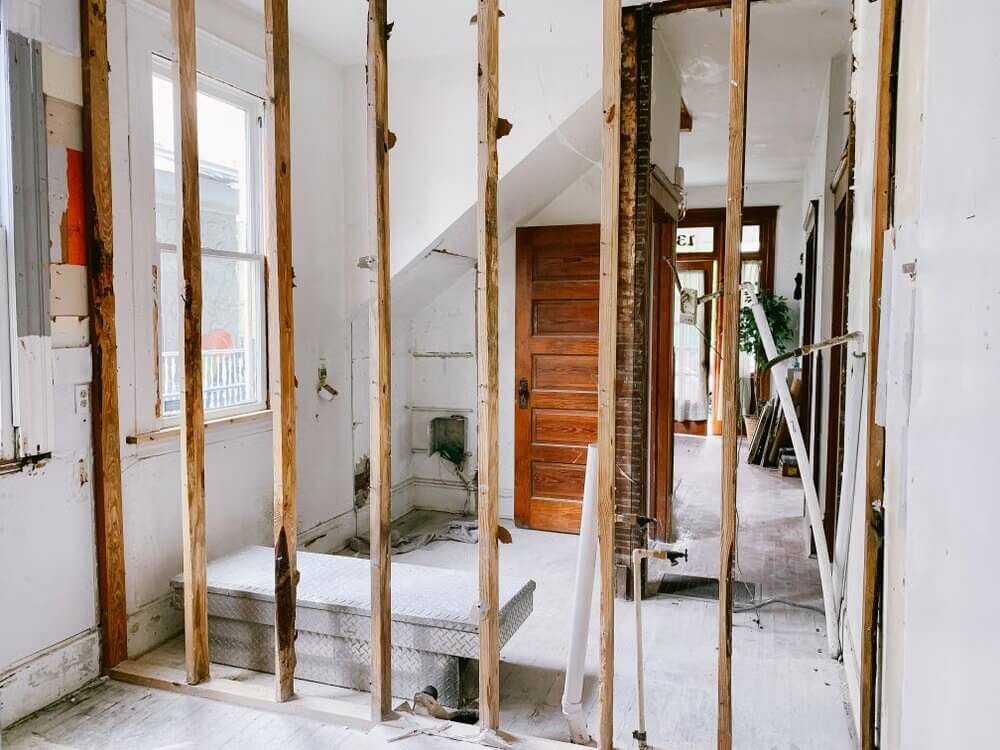
Here the sarking comes off as well and the framing is exposed. It costs extra in labour, dust and skip hire, and it is the only option that lets you deal with what is inside the wall. An electrician can rewire, a plumber can reroute pipes, and insulation can go in.
It also lets us get the framing straight. Old native timber studs are rarely straight or evenly spaced. We find them at odd centres and different depths, with twists that set decades ago. Before lining, they need packing, planing and extra nogs so every sheet edge lands on solid timber.
Nobody notices that work when it is done. Everybody notices when it is not.
Two cautions. Sarking can be doing bracing work in an old house, so have your builder confirm what can come off before whole walls are stripped. And insulating exterior walls usually needs a building consent, so talk to your builder or Auckland Council before the linings come down.
Where Relined Walls Crack Later
When we are called in to repair a reline that has cracked, the damage is nearly always in the same few places.
Sheet joins that land between studs, with only a sarking gap behind them, will open up. So will joins that line up with the corner of a door or window. That corner is where an old house on piles flexes most as Auckland clay dries out over summer and swells again in winter, so we cut the sheet around the opening and keep the join well away from it.
Stud height matters too. Many villas have a 3m stud or higher, which adds another horizontal join running the length of the room. Long sheets laid horizontally keep the number of joins down, and our GIB® stopping team build each one up in full coats with proper drying time between them. A rushed join in a house that moves is the first one to show.
The last weak spot is where a new board meets an old lining in the next room or the hallway. That junction needs a planned detail, such as a door frame or a trim, or it will crack along the change.
When You Do Not Need To Reline
If the scrim is tight, the paper is sound and you are happy with a wallpapered room, you can leave it alone. Fresh lining paper and wallpaper over tight scrim is a legitimate finish for a spare bedroom, or for a room you want to keep in period, and it costs a fraction of a reline. Do not expect to paint it, and do check the insurance.
Check before you assume, too. Plenty of villas have been partly relined over the decades, so one room can be scrim while the next is plasterboard or old lath and plaster. Our guide to how to tell what is on your walls covers the tap test and the other clues.
What Relining A Room Costs
Our published 2026 rates give a fair starting point. Supply and fix of standard 10mm board runs $25 to $33 per m², and Level 4 stopping runs $30 to $45 per m², both excluding GST. Renovation work typically carries a loading of 15 to 30% on the fixing for protection, dust control and working around existing finishes.
Take a 3.6m by 3.6m bedroom with a 2.7m stud. That is roughly 35m² of wall once the door and window are taken out. Supply, fixing and Level 4 stopping would land at around $1,900 to $2,700 plus GST before the renovation loading.
That figure leaves out stripping the scrim or sarking, disposal, straightening the framing, refitting trim and painting. Those items vary the most from house to house, so we price old-house relines from a site visit and never from a floor plan. There is a fuller breakdown in our guide to GIB® fixing costs in Auckland.
Once the walls are stopped and sanded, our house painting team can seal and paint them, so one company answers for the finish from bare framing to final coat.
Talk To Us Before You Strip The Next Wall
If you have found scrim behind the wallpaper, stop at one wall and ask us to look before the rest comes off. We can open a small section, check the sarking and framing, and tell you whether lining over, stripping back or leaving it alone makes sense for that room and your budget.
We work across Auckland and the North Shore, and up through the Hibiscus Coast, Warkworth and Mangawhai.
Get in Touch